

Agemin’s Email Age Estimation: Instant, Privacy‑First Age Verification
Age verification has become a critical requirement for online businesses in an era of strict regulations and heightened safety concerns. Companies must ensure users meet minimum age requirements to comply with laws and to protect minors from inappropriate content. Traditional verification methods—like uploading an ID or entering credit card details—often introduce friction and privacy concerns, potentially driving users away. Agemin’s Email Age Estimation offers a smarter solution: it provides instant, low-friction age checks using nothing more than an email address. Email based age estimation leverages existing digital footprints to estimate user age, offering privacy advantages by minimizing the need for sensitive personal data and is recognized by regulators as a valid, though lower assurance, option for online age verification.
This innovative approach delivers a seamless user experience while helping businesses stay compliant and secure. For privacy reasons, many organizations prefer email-based methods, as they are less intrusive and better aligned with privacy regulations.
Proper usage of email-based age estimation is essential to ensure its validity and compliance with regulatory standards.
Why Accurate Age Verification Matters
Every company serving online users needs a reliable way to verify age. Regulatory frameworks (from COPPA in the U.S. to the UK’s Online Safety Act) increasingly mandate strict age checks for certain services and content. The California Age-Appropriate Design Code (CAADC) also requires companies to perform a Data Protection Impact Assessment (DPIA) regarding their use of children's personal data. Beyond legal compliance, there’s a moral and reputational imperative: ensuring minors are kept away from adult or hazardous content and products. The risk level associated with age estimation methods determines the certainty required for protecting minors online, and companies must assess this when choosing their approach. Effective age verification is also linked to fraud prevention and community trust – by confirming user age, businesses can prevent fraud, safeguard children, and uphold their reputation in the digital marketplace. However, different age assurance methods come with their own risks, particularly regarding privacy and legal compliance, making it essential to develop privacy-protective solutions that mitigate these risks. In short, robust age verification protects both users and businesses, creating a safer, more trustworthy environment for all.
What Is Email Age Estimation?
Email age estimation is a novel verification method of verifying a user’s age by analyzing their email address rather than personal IDs or facial scans. Agemin’s system examines privacy-safe metadata and reputation signalsassociated with an email account to infer whether the owner likely meets a given age threshold (for example 13+, 16+, 18+, or 21+). The process analyzes a user's digital footprint, comparing the submitted address against online databases and metadata sources to estimate the user's age. These signals can include the email’s creation date, domain credibility, and usage patterns, among others, which together paint a picture of the email owner’s probable age group.
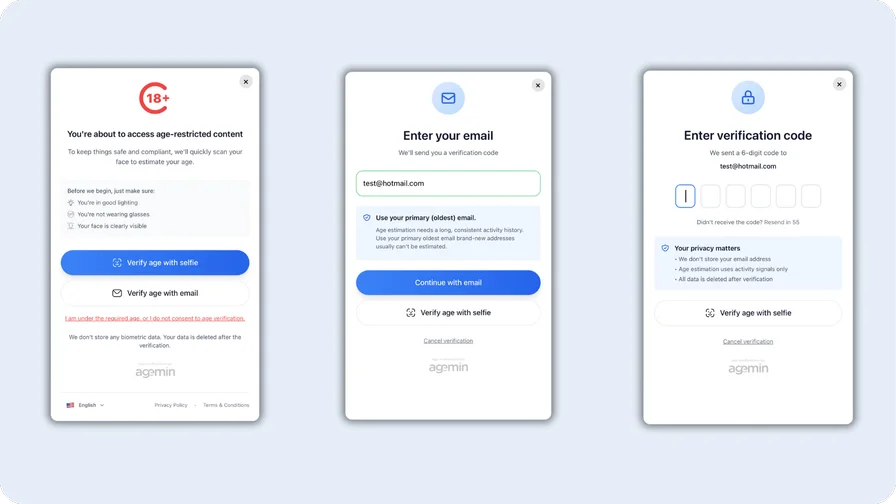
This method is non-intrusive and privacy-friendly. Users simply provide their email address – no sensitive personal data or identification documents are required. To ensure trustworthiness, verifying email ownership (for example, via OTP verification) is often used to confirm that the user legitimately controls the submitted email address. The system then quickly estimates if the user is old enough for the service or content in question, without ever exposing or storing personal information. As a result, companies can verify age “without collecting sensitive personal information,”maintaining user privacy while still enforcing age restrictions. This balance of simplicity and privacy is what makes email-based age verification so appealing. Specialized tools also evaluate if an email address exists in historical databases, determining the legitimacy of the account based on its age.
Simple SDK Integration: Get Started in Minutes, Not Weeks
One major hurdle businesses encounter when implementing age verification is the complexity of engineering. Agemin eliminates this obstacle with developer-friendly SDKs designed for quick, dependable integration across modern technology stacks.
Agemin’s SDKs are user-friendly and intuitive. Instead of requiring teams to build custom verification flows from the ground up, the SDK offers pre-built components that manage the entire Email Age Estimation process—from input to decision—securely and efficiently. This significantly shortens implementation time and reduces the chance of errors.
See this code example:
import Agemin from '@bynn-intelligence/agemin-sdk';
// Initialize SDK (v5.0.0+ uses singleton pattern)
const agemin = new Agemin({
assetId: 'ast_YOUR_ASSET_ID', // From Dashboard → Websites
referenceId: generateUniqueId(), // Your unique reference
mode: 'modal' // or 'redirect'
});
// Start verification
agemin.verify({
onAgePass: (result) => {
// User passed age verification
console.log('Session token:', result.sessionToken);
// Send token to your backend for validation
sendToBackend(result.sessionToken);
},
onAgeFail: () => {
// User is underage
window.location.href = '/age-restricted';
}
});TypeScriptFor product teams, this means:
- No complicated setup or lengthy development cycles
- Minimal changes needed on front-end and back-end systems
- Clear, well-documented functions that integrate smoothly into existing user workflows
Whether embedding age checks into signup forms, checkout processes, or access gates, the SDK enables you to incorporate verification logic with just a few lines of code. The outcome is a consistent, dependable user experiencethat works seamlessly across web and mobile platforms without adding friction.
Equally important, Agemin’s SDKs are built with privacy and compliance integrated. They transmit only the essential data and adhere to strict data-handling protocols by default. This means your development team doesn’t need to build compliance logic from scratch—it’s already embedded in the SDK.
Powerful API Architecture: Flexible, Scalable, and Built for Growth
For teams seeking full control, Agemin’s API-first architecture provides maximum flexibility. The Email Age Estimation API is designed to integrate effortlessly into custom workflows, complex systems, and environments with high demand.
See this code example:
import requests
import base64
# Read image and convert to base64
with open('path/to/image.jpg', 'rb') as image_file:
image_base64 = base64.b64encode(image_file.read()).decode('utf-8')
headers = {
'Content-Type': 'application/json',
'Authorization': 'Bearer private_UcBnjrRsZ7aeYJHGVRgVog9z'
}
data = {
'asset_id': 'ast_EGgttyBFBkseL11KAbNBBW3w',
'image_base64_strict': image_base64,
'reference_id': 'user_123' # Optional: your reference ID
}
response = requests.post(
'https://api.agemin.com/v1/agemin/check/selfie',
json=data,
headers=headers
)
print('Age verification result:', response.json())Python
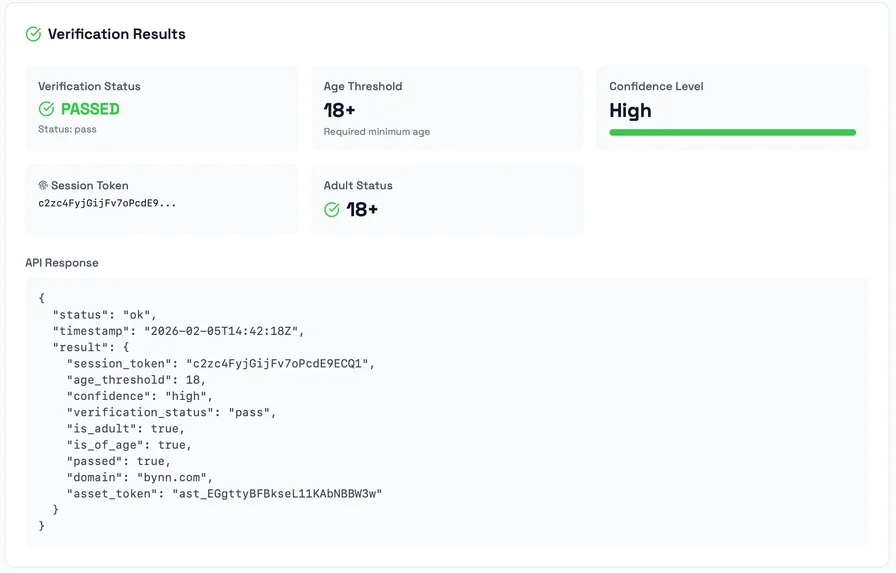
With a single API call, businesses can:
- Submit an email address for age estimation
- Receive an immediate age eligibility decision
- Customize age thresholds by region or specific use cases
- Trigger additional verification steps only when necessary
The API delivers real-time responses, ideal for high-traffic platforms where speed is crucial. Decisions are returned in milliseconds, allowing businesses to enforce age restrictions without slowing down onboarding, purchases, or access requests.
From a scalability standpoint, the API is built to grow with your needs. Whether verifying hundreds or millions of users, the infrastructure automatically scales to maintain consistent performance during traffic surges or seasonal peaks. This makes it especially beneficial for platforms experiencing rapid expansion or operating across multiple markets.
The API also integrates smoothly with existing KYC, KYB, AML, and risk decisioning systems, enabling age verification to be part of a broader compliance and trust framework. Features like webhooks, logs, and analytics endpoints facilitate monitoring outcomes, auditing decisions, and refining policies over time.
In summary, Agemin’s API offers businesses complete control without added complexity—a rare combination that supports both innovation and compliance at scale.
How Agemin’s Email Age Verification Works
Agemin’s Email Age Estimation workflow is designed for speed and security, fitting seamlessly into your existing user flows:
- Submit Email: The process begins when a user enters their email on your platform. Through a simple API call or a hosted verification flow, this email is transmitted to Agemin for analysis. (For developers, it’s as straightforward as a POST /verify/email request to Agemin’s API.)
- Signal Analysis: Once the email is received, Agemin’s AI models get to work. They evaluate various non-content signals from the email metadata – things like the email’s age (how long ago it was created) and other reputation indicators – to estimate the user’s age, all while preserving user privacy. Importantly, the analysis avoids looking at any personal email content; it only uses peripheral data, ensuring the user’s communications remain private. To incorporate anti-spoofing and fraud prevention, the process issues a time-restricted one-time-password (OTP) to prove email ownership.
- Policy Decision: Agemin then compares the estimated age against your predefined age threshold. If the model is confident the user meets (or exceeds) the required age, the verification passes instantly. If the result is borderline or the user likely does not meet the age requirement, Agemin can flag the case for a “step-up” verification. In step-up scenarios, you might choose to require an alternate method (such as a quick selfie for facial age estimation or an ID upload) to double-check the age. For high-risk scenarios that require stronger verification, email age estimation may not be suitable, and additional robust verification methods should be considered. This tiered approach ensures that only higher-risk or uncertain cases face additional friction, while the vast majority of users sail through with just their email.
- Audit & Analytics: Every decision and outcome can be logged and reviewed. Agemin provides dashboards and webhooks to monitor verification results in real-time. Businesses can audit the age checks, observe trends (such as how many users are being verified via email alone), and adjust settings if needed. This transparency and control help maintain fairness and reliability, for example by catching edge cases like multiple family members sharing one email or detecting if many very new emails are attempting verification.
Thanks to this streamlined pipeline, Agemin’s email-based verification returns decisions in under 100 milliseconds on average. In practical terms, that means a user can enter their email and get verified almost instantly, without slowing down signup or checkout flows. The entire process happens behind the scenes, preserving a smooth experience.
Email Address Age
Email address age estimation stands out as a highly effective and technically robust method of age assurance for online services. By leveraging a user’s digital footprint, this approach estimates the likely age of an individual based on the history and metadata associated with their email address. Unlike more intrusive age assurance methods—such as facial age estimation or document uploads—email address age estimation offers a seamless user experience that respects privacy while delivering reliable results.
The process works by analyzing the age of the email address itself, drawing on a variety of online databases and metadata sources to determine when a particular email account was created and how it has been used over time. This data-driven approach, often powered by advanced machine learning and artificial intelligence, enables businesses to estimate a user’s age with a high degree of technical accuracy. As a result, online platforms can confidently prevent minors from accessing age-restricted content or services, such as online gaming, social media accounts, or e-commerce sites selling regulated products.
One of the key advantages of email address age estimation is its non-intrusive nature. Users are not required to submit sensitive personal information or biometric data, making the process both privacy-preserving and user-friendly. This is particularly important for businesses seeking to comply with global regulations like the UK’s Online Safety Act, the EU’s Digital Services Act, or the US Children’s Online Privacy Protection Act (COPPA). Email address age estimation is recognized as a valid method of age assurance under these frameworks, helping companies meet regulatory requirements without introducing unnecessary friction into the user journey.
Beyond compliance, this method supports a wide range of use cases. Online services can use email address age estimation to implement effective age gates, tailor age-appropriate experiences, and enable parental controls or consent flows where needed. For example, a social media platform might use this method to restrict account creation to users above a certain age, while an online gaming service could ensure only eligible players access age-rated content. The flexibility of this approach means it can be adapted to different risk levels and regulatory environments, providing a scalable solution for businesses of all sizes.
In summary, email address age estimation is a reliable, privacy-first, and highly effective option for age assurance. By utilizing existing data and sophisticated age estimation methods, businesses can protect children online, comply with regulatory requirements, and deliver a seamless user experience. Whether you are looking to prevent minors from accessing restricted content, enable parental controls, or simply provide age-appropriate experiences, email address age estimation offers a robust and technically accurate solution that meets the demands of today’s online safety landscape.
Key Features of Agemin’s Email Age Estimation
Agemin’s solution comes packed with features that make age verification both effective and effortless:
- Instant Results: The system is built for speed. Verification decisions typically come back in a fraction of a second (response time < 100ms), ensuring users don’t wait around and drop off. This lightning-fast response keeps your onboarding and purchase flows moving seamlessly.
- Privacy-First Design: User privacy is at the core of Agemin’s approach. No ID, credit card, or personal details are required beyond the email address. The platform is built on data minimization principles – you decide what minimal data to send and what (if anything) to retain. Agemin itself stores no personally identifiable information (PII), so you and your users can be confident that sensitive data won’t be stockpiled on external servers. This privacy-by-design approach also makes it easier to comply with data protection regulations.
- High Accuracy & Compliance: Behind the scenes, Agemin’s AI model is highly sophisticated. In fact, the company has claimed its technology “outperforms all known competitors on the market” in accuracy tests. For businesses, this means reliable age checks you can trust. Agemin’s service aligns with global regulatory standards and published guidelines (including those from the UK and other regions) to help you stay compliant. The system achieves a very high compliance success rate (98% as cited in Agemin’s materials) in meeting age-verification requirements during real-world deployments.
- Our email age estimation is considered highly effective by Ofcom in the UK when used in appropriate contexts.
- Email address age estimation is highly accurate, as demonstrated by its Age Check Certification Scheme (ACCS) EAL 3 certification – the highest possible level for age estimation methods.
- Minimal User Friction: Because the method is invisible and instant, users encounter virtually no friction. There are no forms to fill out beyond the email, no documents to upload, and no awkward selfies needed just to prove one’s age. This low-friction experience means higher conversion rates – more users complete onboarding or checkout instead of abandoning out of frustration. It’s a win-win: you get assurance of their age, and they get a painless verification.
- Flexible Integration: Agemin offers multiple ways to integrate the age estimation service into your product stack. You can call a RESTful API, use provided SDKs, or even deploy a hosted verification link for a plug-and-play solution. This flexibility allows teams to implement age checks with minimal engineering effort, adapting to your roadmap. You can also configure custom age thresholds per region or product, set up workflows for uncertain cases, and define fallback options (for instance, automatically trigger an ID check if email verification isn’t conclusive). Agemin’s integration is designed to slot into any modern tech stack, whether you’re running a mobile app, web platform, or in-store system.
- End-to-End Solution with Multi-Method Support: Email Age Estimation is part of Agemin’s comprehensive age verification platform. Agemin supports multiple age verification methods – including facial age estimation and document verification – all under one roof. This means you can rely on a single vendor (and a unified dashboard) for all your KYC/AML age compliance needs. Use the email-based check as a first-line filter for speed and convenience, and step up to facial or document checks only when necessary. This layered approach ensures maximum security and compliance with minimal inconvenience, something few alternatives offer in such an integrated fashion.
- Analytics and Fairness Controls: Agemin provides built-in analytics to monitor how the age checks are performing across different user groups. You can detect any bias or anomalies (for example, if a particular cohort of users is often failing the email check) and adjust thresholds accordingly. There’s also support for manual review in rare edge cases, such as very new email addresses or shared family emails that might confuse automated signals. These controls help maintain fairness and accuracy, ensuring the system works reliably for a diverse user base without unintended discrimination.
- Technical Description: Companies like Verifymy and Yoti maintain databases of aggregated, anonymized user data to determine when an email was first used, which enhances the accuracy and reliability of email age estimation.
Benefits for Your Business
Deploying Agemin’s Email Age Estimation can deliver significant benefits for companies across sectors:
- Regulatory Compliance Without Headaches: By automatically verifying user ages, your business can ensure compliance with global regulations (from GDPR-aligned age rules to sector-specific laws) and avoid costly penalties. Agemin’s solution is GDPR-compliant and SOC2 certified out of the box, indicating strong data protection and security practices. You can meet age verification mandates (like those for online alcohol sales or adult content access) confidently and swiftly.
- Protection of Minors and Community Trust: Age estimation helps prevent children from accessing inappropriate content or services, protecting vulnerable users. This not only fulfills a social responsibility but also enhances the trust and safety of your platform’s community. Parents and regulators alike will have greater confidence in a platform that actively safeguards minors.
- Enhanced User Experience & Conversion: Traditional age checks can be cumbersome—imagine asking every new user to scan their ID or credit card. Agemin’s email-based approach eliminates those hurdles, providing a frictionless verification that users often won’t even notice. The result is a smoother onboarding or checkout process, leading to higher conversion rates and lower abandonment. Users appreciate not being subjected to invasive checks just to prove they’re old enough; this positive experience can differentiate your service in a competitive market.
- Operational Efficiency and Cost Savings: Automating age compliance via email signals means lower operational overhead. There’s no need to maintain a manual review team to check IDs for age, except in the few edge cases where further verification is warranted. Agemin’s system runs 24/7 in real-time, so you’re always covered without staffing worries. By filtering out underage users or risky new accounts early (in milliseconds), you also reduce the chances of having to deal with compliance violations or fraudulent users later on, which can save money and reputation in the long run.
- Broad Coverage and Inclusivity: Not everyone has a government-issued ID readily available, and in some regions or demographics, expecting an ID or credit card can exclude legitimate users. Email, however, is nearly universal. By leveraging email-based age checks, you create an inclusive verification process that welcomes users from all backgrounds (including those who might not have a driver’s license or who are privacy-conscious). This broad coverage means you don’t turn away would-be customers simply due to documentation hurdles. Agemin’s approach works for anyone with an email account and is designed without bias toward any user group.
Use Cases Across Industries
Because it’s so flexible and user-friendly, Agemin’s Email Age Estimation can be applied in a wide range of industries and scenarios. Here are some prime examples:
- Social Media & Online Communities: Platforms that host user-generated content or facilitate interactions (forums, chat apps, social networks) often set minimum age requirements (e.g. 13+ for many services). Agemin enables these platforms to gate account creation and certain features so that users under the required age can’t simply lie and get in. This is especially important for communities dealing with sensitive or adult-oriented content. The age check happens instantly at signup, helping social platforms comply with laws and create safer online spaces.
- Online Gaming & Streaming: Gaming networks and streaming services must enforce regional age rating rulesand enable parental controls for younger audiences. For example, a game might be 18+ in one country and 16+ in another. By integrating email age verification, these services can automatically ensure each user meets the appropriate age before letting them play or view content. The process can also support parental consent flows – a parent’s email could be verified for permission, etc. – all with minimal disruption to the gaming experience.
- E-Commerce (Alcohol, Tobacco, etc.) & Delivery Services: If your online store sells age-restricted goods (like alcohol, vape products, or certain medications), verifying customer age is legally mandatory. Agemin’s solution can be dropped into the checkout process to screen eligibility for age-restricted products. Customers simply provide an email as usual; behind the scenes Agemin confirms they are of legal purchasing age. This is far more convenient than requiring an ID upload during checkout. It also works for delivery apps (e.g., alcohol delivery) to check age before dispatching a driver, and can complement in-person ID checks at delivery as an added assurance layer.
- In-Store Kiosks & Unattended Retail: Self-service checkout kiosks or vending machines that sell age-restricted items (think self-checkout in a supermarket for wine, or vending machines for lottery tickets) can use email age estimation as a quick screen. Instead of calling an attendant over or scanning an ID, a user could input their email for a rapid age check. It’s a quick alternative to manual ID scans that keeps the self-service flow fast and private. This enhances customer experience in retail environments by reducing wait times and embarrassment, while still upholding legal requirements.
- Advertising & Content Moderation: In digital advertising (adtech) and content publishing (martech), there’s a need to tailor content based on user age. For instance, serving mature-rated ads only to adults, or ensuring teen users see only age-appropriate content. Agemin’s email-based verification allows websites and ad networks to apply age-appropriate experiences with minimal data collection. This is particularly useful in jurisdictions like the UK, where standards require rigorous age checks for certain online content. Implementing email age estimation helps these businesses comply with standards (like the UK Online Safety Act) while respecting user privacy.
These examples are just the beginning. Any scenario where you need a fast, reliable age gate – without chasing away your customers – could potentially benefit from Agemin’s solution. From dating apps to educational platforms, the applications are broad.
Why Choose Agemin Over Other Solutions?
Agemin’s Email Age Estimation stands out in an increasingly crowded age verification market. Here’s why it’s a cut above the rest:
- Unmatched Combination of Speed and Privacy: Some verification solutions prioritize accuracy but at the cost of user data privacy (for example, scanning government IDs), while others aim for convenience but sacrifice reliability. Agemin strikes the ideal balance by delivering both instant speed and strong privacy. Users don’t feel spied on or slowed down, which encourages compliance rather than avoidance. This balance translates into higher user adoption of the age check process, something competitors struggle with when their methods are too invasive or slow.
- Comprehensive Platform (Beyond Just One Method): Unlike single-method services, Agemin offers a multi-method platform that includes facial age estimation, document verification, and content monitoring alongside email age checks. This means if the email method ever flags uncertainty, you can seamlessly escalate to a facial scan or ID check within the same system. No need to juggle multiple vendors or integrations – Agemin provides an all-in-one age and identity verification ecosystem. This not only simplifies your tech stack but also ensures consistent reporting and compliance control across all verification methods.
- Cutting-Edge AI Accuracy: Agemin leverages advanced AI models that have been benchmarked against industry standards. The company has reported achieving significantly low error rates in age estimation, demonstrating industry-leading accuracy in internal tests. While exact performance can vary by method (facial vs. email), Agemin’s commitment to accuracy means you can trust the results. Fewer false negatives (letting underage users slip by) and fewer false positives (wrongly turning away legitimate customers) translate to a safer platform and a smoother business operation.
- Compliance and Security Assured: Agemin is built from the ground up with compliance in mind. It supports adherence to regulations such as GDPR in the EU, COPPA in the US for children’s online privacy, and the UK’s Online Safety regulations. Choosing Agemin means choosing a partner that stays on top of evolving legal requirements in the age verification space. Moreover, the service is SOC 2 certified and maintains high security standards, giving you and your customers peace of mind that data is handled responsibly. Not all competitors can claim this level of compliance-readiness and certification.
- Ease of Implementation and Support: With Agemin, getting started is quick. You can be up and running in minutes by using their out-of-the-box API or SDK tools. The company offers robust documentation and developer support to guide integration. If you prefer a zero-code approach, the hosted verification link can drop into your site immediately. Agemin’s team also provides sales and technical support to customize the solution to your needs (e.g., setting custom age rules for different countries or content types). This level of flexibility and assistance means even smaller companies or startups can implement enterprise-grade age verification without a huge lift.
In summary, Agemin’s Email Age Estimation outshines other options by being faster, more private, and more comprehensive. It embodies a modern approach to KYC/AML compliance for age requirements—one that doesn’t trade user experience for security. Businesses that adopt Agemin gain a competitive edge: they can confidently claim to protect minors and comply with laws, all while offering a smooth onboarding that doesn’t scare away customers. Agemin essentially lets you “have your cake and eat it too” when it comes to age verification: maximum assurance with minimum friction.
Conclusion
Age verification no longer needs to be a thorn in the side of online businesses. With Agemin’s Email Age Estimation, you have access to an instant, privacy-first age assurance tool that keeps users safe and satisfied in equal measure. This solution was crafted for the modern internet landscape—where user experience is king but compliance is non-negotiable. By leveraging the humble email address as a key to unlock age information, Agemin helps companies protect minors, reduce operational overhead, and keep conversion rates high.
If your company operates in a regulated space or simply values creating a secure community, now is the time to embrace smarter age verification. Agemin’s Email Age Estimation empowers you to meet your legal obligations and ethical responsibilities without sacrificing growth or user trust. It’s a forward-thinking approach that demonstrates to your users and regulators alike that you take digital safety seriously. In a world where trust is hard to earn and easy to lose, implementing such a solution is not just about checking a compliance box—it’s about building a platform that people of all ages (and their parents) can trust.
Ready to upgrade your age verification process? With Agemin, you can get started in seconds – create a free account or try a live demo to see how email-based age verification can transform your onboarding today. Embrace the future of age assurance and let your business grow with confidence, backed by Agemin’s cutting-edge technology.
Want to learn more?
Explore our other articles and stay up to date with the latest in age verification and compliance.
Browse all articles