
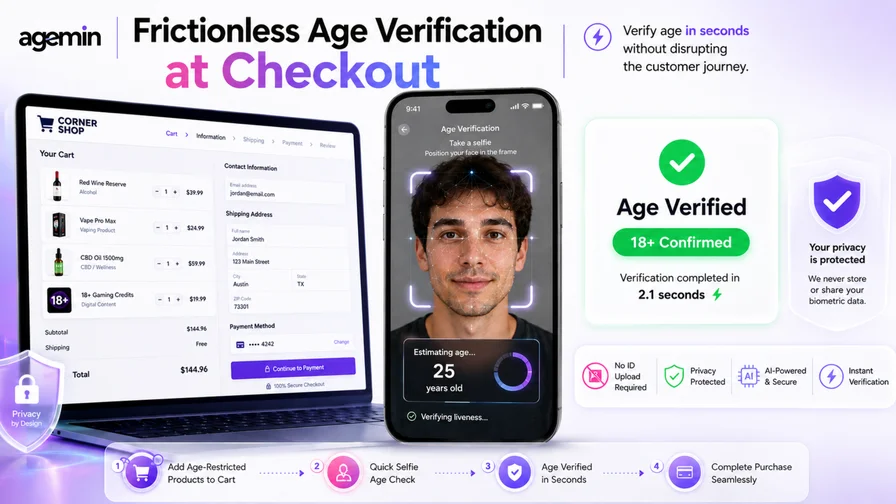
Age Verification Ecommerce: Sell Age-Restricted Products Without Losing Sales
Why age verification matters more than ever
Age verification used to be treated like a thin compliance layer. A modal. A checkbox. A single line of text saying “By entering, you confirm you are over 18.” That era is ending.
Across regulated categories, enforcement has become more concrete and less forgiving. In the United States, the FDA says it surveils thousands of websites each year, has issued hundreds of warning letters to online retailers operating websites that illegally sold tobacco to underage people, and can escalate to civil money penalties or no-tobacco-sale orders. Federal tobacco law also sets the minimum age at 21, while ATF’s PACT Act materials make clear that remote sellers must comply with applicable state laws and local laws, perform age verification, and face criminal and civil penalties for violations. Retailers must verify age for certain products sold online because regulations require effective age verification for online sales.
The same pattern shows up elsewhere, but with different rules. In the Netherlands, remote alcohol sellers must verify age twice: once before purchase and again at delivery. In the UK, all online gambling businesses must verify age and identity before gambling, often using database matching first and documents if the electronic check is insufficient. And in the UK online safety regime, Ofcom has already moved from guidance to enforcement, announcing fines for services that failed to implement robust age checks and reporting that age checks are expanding across social media, dating, gaming, messaging, and adult services.
This is why ecommerce age verification now sits at the intersection of legal risk, operational risk, and revenue risk, underlining the importance of protecting businesses from legal issues while meeting legal requirements and broader regulatory requirements. Sell to a minor and you are not just dealing with a bad transaction. Depending on the sector and jurisdiction, you may be dealing with lawsuits and fines, license exposure, delivery restrictions, record-keeping duties, platform trust issues, or reputational damage that is far more expensive than the original basket value; in the US, selling alcohol to minors is illegal, and alcohol sales to anyone under 21 require verification.
The pressure is also widening geographically. The European Commission is actively pushing privacy-preserving proof-of-age tools, including an EU-wide age verification approach that lets users prove they are over 18 without sharing unnecessary personal data, with rollout targeted by the end of 2026. Regulators are not moving toward “less age assurance.” They are moving toward age assurance that is real, auditable, and proportionate to product risk under current regulations.
The hidden cost of weak or clunky age gates
The most dangerous age gate in ecommerce is often the one that feels the safest internally. It is easy to deploy. It creates almost no engineering work. It appears to “cover” compliance. A pop up or checkbox does not verify a website visitor in any meaningful way, and it fails exactly when it matters.
Official guidance is blunt on this point. Ofcom says self-declaration on its own is not capable of being highly effective age assurance, including a simple date-of-birth field with no supporting evidence or a checkbox confirming the user is over 18. The ICO says self-declaration is not an effective way to prevent underage access because it is easily circumvented. In other words, the classic “Are you 18+?” gate is low-friction, yes, but self-declaration provides very low security against minors and mainly serves superficial compliance.
That weakness creates one kind of cost. Friction creates the other.
Baymard’s checkout research puts average cart abandonment at about 70.19%. Not all of that is fixable, of course, but the data still matters because it shows how fragile checkout already is before you add age checks. In Baymard’s current abandonment statistics, 18% of shoppers report abandoning because checkout was too long or complicated, and 19% abandoned because they did not trust the site with their credit card information. Separately, Baymard found 27% of online shoppers are reluctant to provide their date of birth to an online store. Another study found 76.69% of users prefer low-friction age checks. Add an unnecessary document upload or a confusing extra step at the wrong moment, and you are pressing directly on existing abandonment triggers in the verification process.
This is the real ecommerce dilemma. A weak age gate leaks compliance. High-friction methods can reduce conversion during checkout, so balancing compliance with user experience is critical to the user journey.
Manual document checks illustrate the trap. They can be necessary, and in some contexts they are the right answer. But they are clearly not the best default path for everyone. The UK Gambling Commission notes that electronic verification can be instant, while document-based checks take longer. The ICO adds that hard-identifier approaches can exclude or indirectly discriminate against users who lack passports, driving licences, or sufficient database footprints. So if every customer is forced down the strictest possible path, the business may become legally safer on paper while making the journey slower, more invasive, and harder to complete.
Poor age verification also chips away at trust. People notice when a brand asks for more data than seems necessary. The problem is not just inconvenience. It is suspicion. If the user thinks, “Why are they asking for this?” the purchase starts to feel less safe, not more. Baymard’s findings on checkout transparency, and the ICO’s emphasis on telling users what data is being collected, why it is needed, whether a third party is involved, and how long it is kept, point in the same direction: explain the check clearly, and effective age verification can build customer trust in e commerce among consumers while helping maintain confidence.
Modern age verification methods compared
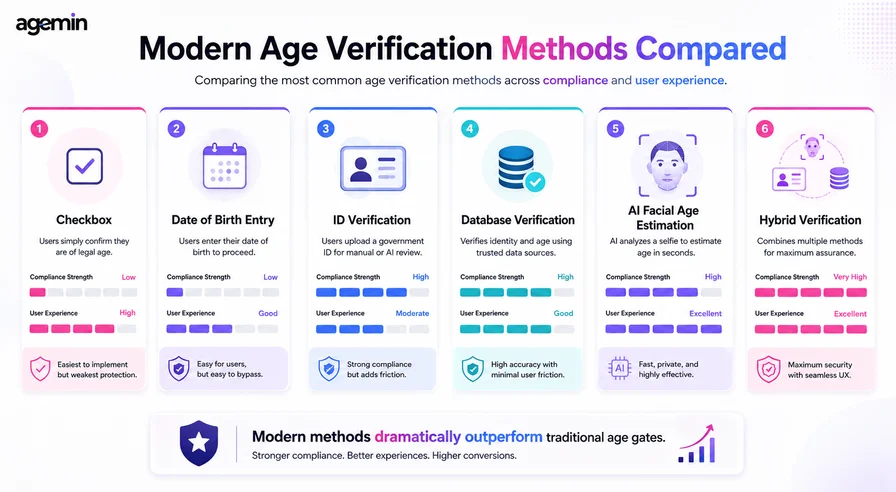
No single method is best for every product, jurisdiction, or risk profile. Effective age verification solutions should match method strength to product risk while balancing security and user experience, even though that balance is often challenging for organizations. The table below is a practical synthesis of regulator guidance, privacy guidance, technical evaluation, and checkout UX research rather than an official regulator scorecard. Methods for age verification range from self-declarations to secure document checks, and they must comply with local regulations. Exact legal sufficiency depends on the product, country, age requirements, whether identity must be established, and whether a second check is required at delivery or withdrawal.
| Method | Compliance strength | Customer experience | Where it fits best | Main weakness |
| Self-declaration checkbox | Very low | Excellent | Low-stakes preference gating only | Easily bypassed |
| Date-of-birth entry | Low | Good | Low-risk segmentation | Unverified input; users may resist sharing DOB |
| ID document verification | High | Moderate | Regimes requiring exact age or identity | Friction, privacy burden, exclusion risk |
| Database verification | High | Good | Fast electronic checks in supported markets | Coverage varies; ownership proof may still be needed |
| AI facial age estimation | High | Excellent | Mobile-first screening, onboarding, fast checkout | Performance varies near threshold; some laws need stronger proof |
| Hybrid waterfall model | Very high | Excellent when tuned well | Cross-border and higher-risk use cases | Policy design and fallback logic are more complex |
Self-declaration and date-of-birth entry are the weakest options on the compliance side because regulators increasingly treat them as insufficient in isolation. Ofcom explicitly says that an unauthenticated DOB entry or a simple 18+ checkbox is not capable of being highly effective. The advantage is obvious: almost no friction. The disadvantage is just as obvious: almost no meaningful assurance.
ID document verification remains one of the strongest methods when you need exact age, exact date of birth, or proof that the person presenting is the same person named on the credential. Secure document checks provide high assurance. The trade-off is friction. The ICO notes that hard identifiers can exclude users who do not have the required documents, and that in many cases it may be excessive to inspect an official document if a less intrusive method can still deliver proportionate assurance.
Database verification is the quiet workhorse in many regulated flows. Ofcom lists open banking, mobile-network age checks, credit-card checks, email-based age estimation, and digital identity services among methods that can be capable of being highly effective when implemented properly. The UK Gambling Commission describes how operators often use database sources such as credit reference agencies or the electoral roll, with documents requested only when the database match is not enough. Checks that validate a user's age against public records are effective against most minors, but this method has limits: coverage is uneven, not every adult has the right data trail, and Ofcom says providers should still verify ownership of details through measures such as one-time passcodes or multifactor checks where relevant.
AI facial age estimation has become the most interesting option because it changes the economics of compliance. Ofcom lists facial age estimation as a method capable of being highly effective. The ICO describes age estimation as potentially more privacy-friendly than hard identifiers because it does not require documentary evidence. Biometric verification can strengthen identity verification when higher assurance is needed. Still, the method has to be deployed carefully: regulators expect testing, challenge-age buffers, anti-circumvention controls, fairness monitoring, and fallback routes for edge cases.
Hybrid models, sometimes called waterfall models, are where the strongest modern implementations are heading. The ICO describes a pattern in which age estimation handles obvious cases, while a second method is used only when the first result is borderline or insufficient. In practice, a combination of methods based on risk level is recommended: lower-risk purchases may use lightweight database checks first, with document verification as a fallback for low-confidence cases. This is the sweet spot for ecommerce: high assurance where you need it, low friction where you do not, which is why many age verification services and other solutions use this approach for products with stricter age restrictions.
How AI facial age estimation reduces friction
AI facial age estimation matters because it breaks an old assumption. Compliance does not always have to mean document upload, because AI age estimation can serve as the first line of verification before stronger checks are used.
Ofcom includes facial age estimation in its list of methods that can be highly effective. NIST’s latest age estimation evaluation says photo-based age estimation offers a potential way to control access to age-restricted activities without compromising privacy, and reports that best mean absolute error on a common benchmark improved from 4.3 years in 2014 to 3.1 years in 2024. That improvement is important, because it shows the technology is not standing still.
But the most important lesson from NIST is not “AI is perfect.” It is that performance varies. NIST found no single clearly dominant algorithm, and accuracy is affected by image quality, age band, sex, region of birth, and other factors. Ofcom makes the same point in regulatory language: any system that relies on AI or machine learning should be tested for technical accuracy, robustness, reliability, and fairness, with monitoring over time for drift and for discriminatory outcomes. That is exactly why businesses should resist the temptation to treat facial age estimation like magic. It works best when wrapped in policy.
That policy is usually a challenge-age framework. Ofcom says providers using age estimation should apply a challenge-age approach, much like “Challenge 25” in physical retail. If the legal threshold is 18, you do not simply pass everyone estimated at 18. You set a higher internal threshold, such as 25, so clearly older adults pass instantly while anyone closer to the boundary is routed to a second check. Ofcom says this reduces the risk of incorrectly treating a child as an adult, and NIST’s challenge-age analysis shows why the buffer matters near the edge, making it critical to set thresholds carefully to avoid unnecessary complexity while keeping the flow compliant.
This is where facial age estimation shines for ecommerce. Facial analysis can enhance age estimation without requiring sensitive ID numbers. The interaction can happen in seconds, on a mobile camera, with far less user effort than photographing a document, aligning corners, waiting for OCR, fixing glare, and then often taking a selfie anyway. Low-friction age checks can finish in one second, and 90% of verifications complete in under five seconds. The ICO says age estimation can be suitable for onboarding and ongoing monitoring, and explicitly frames it as potentially more privacy-friendly than hard identifiers. In practice, that makes it especially attractive for mobile commerce, subscriptions, fast checkout, gaming, and other flows where the user has a strong incentive to finish quickly but little patience for ceremony.
Still, realism matters. Facial age estimation is not a universal replacement for stronger proof. In U.S. tobacco delivery sales, ATF guidance under the PACT Act requires database-based age verification, adult signature, and proof of age at delivery. Dutch remote alcohol sales require age verification both before purchase and upon delivery. UK gambling rules require proof of age and identity before play. So the right framing is not “AI replaces everything.” The right framing is “AI can remove friction from the majority path, while stronger proof is reserved for the minority of cases or the jurisdictions that legally require it.” AI age estimation can also reduce checkout abandonment while ensuring compliance.
Privacy and customer trust
Privacy is now part of conversion strategy. Not separate from it. Part of it.
Pew found that 81% of Americans are very or somewhat concerned about how companies use the data they collect about them, and about half say they have recently decided not to use a product or service because they were worried about how much personal information would be collected. That is not a niche sentiment. It is mainstream consumer behavior.
That matters because age verification touches exactly the kind of information people are sensitive about: date of birth, ID documents, facial images, payment details, device metadata. If the business collects more than is needed, or cannot explain why it is needed, the age check stops feeling like protection and starts feeling like surveillance.
Data minimisation is the legal backbone of a better approach, meaning collecting only the data necessary for verification. The ICO’s guide to the UK GDPR states that personal data must be adequate, relevant, and limited to what is necessary. In its age-assurance guidance, the ICO goes further: in many cases it may be excessive to inspect an official document, because a less intrusive method may be sufficient and proportionate; often, the business may only need a yes/no output indicating whether someone meets the age threshold. The ICO also says personal information collected for age assurance should not be repurposed for incompatible uses such as advertising profiling, and privacy obligations also need to address rules such as GDPR and CCPA.
This is why privacy-first age assurance is so commercially powerful. It can reduce legal exposure and user discomfort at the same time. A well-designed system proves the thing you need to know, and not everything else. It can also be applied at the point of service to better respect user privacy.
There is also an important distinction between identity matching and age estimation. The ICO explains that biometric recognition used to match a face to a passport photo is unique identification and therefore special-category biometric processing. Age estimation, by contrast, is classification rather than confirmation of identity; it can be less intrusive, but it still needs governance, fairness testing, data protection controls, and compliance with local privacy laws. So the privacy story for facial age estimation is not “no regulation.” It is “less identity exposure, if implemented properly.”
The direction of travel in Europe reinforces this. The European Commission’s age-verification approach is explicitly built around user-friendly, privacy-preserving proof of age. Its EU solution is designed to let a user prove they are over 18 without sharing other personal data, and the Commission’s recommendation calls for anonymous proof-of-age technologies that meet high privacy and security standards around the world. That is the clearest signal possible: future-proof age assurance will be attribute-based, not identity-hungry. Verification images or related data should be deleted after processing when retention is not necessary.
Building a low-friction verification flow
The best age verification journey is not the strictest journey. It is the journey that is strict only where it has to be, and the age verification process should balance compliance, security, and user experience. In practice, that means the process should be proportionate enough to stay secure without turning checkout into friction for legitimate buyers.
Regulators increasingly describe age assurance in risk-based, proportionate terms. The joint Ofcom-ICO statement says their approach is risk-based, flexible, tech-neutral, and future-proof. The ICO says the age-assurance method should be proportionate to the risks, and that businesses should consider whether a less privacy-intrusive approach can achieve the same objective. The ecommerce translation is straightforward: do not make every buyer climb the highest wall if only a small percentage of high-risk or borderline cases need that level of proof.
A sensible low-friction flow usually looks like this:
Restricted item added to cart* → trigger a quick first-pass check only when necessary → for low-risk purchases, use lightweight verification such as database checks before stronger escalation → use facial age estimation or another low-friction method for the majority path → instantly pass users who are clearly above the challenge age → route borderline or higher-risk cases to a stronger second step such as database or document verification → where the law requires it, add adult-signature or delivery-time proof of age.*
That model solves several problems at once.
Maintaining a clear audit trail of verification events supports regulatory auditing without changing the customer-facing flow.
First, it keeps the fast lane fast. Adults who obviously meet the threshold should not be punished with manual review. The challenge-age model exists precisely to separate clear cases from borderline ones.
Second, it reduces unnecessary data collection. The ICO warns that a poorly designed waterfall model can collect extra information without providing meaningful extra assurance, creating data-minimisation risk. So the second check should be targeted, not automatic.
Third, it respects device reality. Checkout is already hard on a phone. Baymard’s mobile checkout research highlights the friction created by small screens, a reduced page overview, and unnecessary fields. That makes mobile-friendly age verification essential, not optional. If the verification step feels like a side quest on mobile, conversion will suffer.
Fourth, it improves trust through disclosure across the broader user journey. The ICO says users should be told why age assurance is being used, what data is required, whether a third party is involved, and how retention works. Baymard shows that unexplained requests for personal data make users suspicious. So a brief explanation such as “We verify age to comply with local law and protect minors; we only record whether you meet the threshold” is not fluff. It is conversion infrastructure.
Finally, the flow needs a human escape hatch. The ICO says if you use a waterfall technique, people must be able to challenge the decision. That matters both legally and commercially. Adults will sometimes be misclassified. A dead end is a lost sale and, in some sectors, a complaint waiting to happen.
How Agemin helps ecommerce businesses
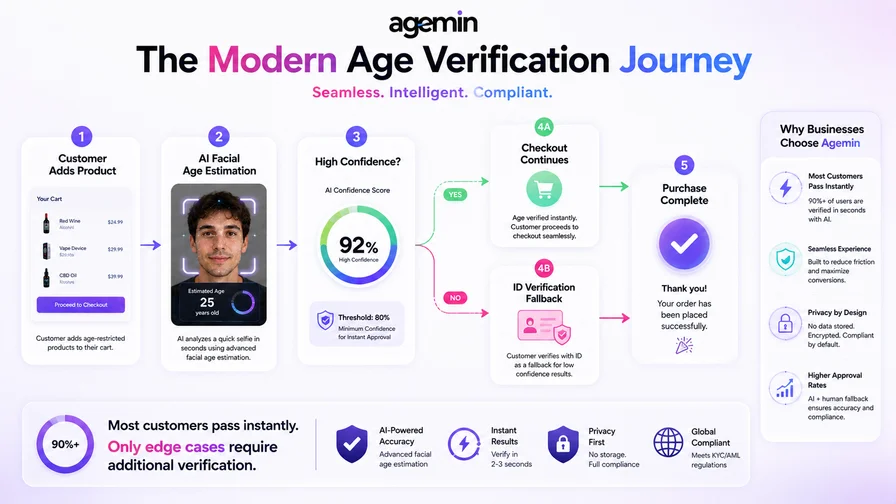
Based on Agemin’s public product and solution materials, the company is building around the exact model that modern regulators and ecommerce teams increasingly prefer: a fast first-pass age check, privacy-aware architecture, and step-up controls for the harder cases across ecommerce platforms.
On the ecommerce side, Agemin’s public solution page says merchants can trigger age checks from the product page, cart, or checkout; run a quick facial scan with automated liveness and age analysis; receive the result server-side; and remember the session so verified customers do not have to re-verify needlessly. The same materials emphasise mobile and desktop compatibility, modal or redirect options, and policy outputs such as pass/fail or over/under-threshold decisions that can be mapped directly into storefront logic. For ecommerce leaders, that combination matters because it moves age assurance closer to an orchestration problem than a UX detour.
Agemin’s facial-age-estimation materials position the product as a live-selfie, privacy-first flow with liveness detection, fast processing, and threshold tuning by geography, product type, or session risk. Public pages also say the product is intended to let low-risk users pass instantly while routing uncertain cases to stronger checks, while stronger fallback checks elsewhere in the market often use selfies and IDs for identity verification. That is very close to the waterfall logic endorsed by the ICO and the challenge-age design described by Ofcom.
Agemin also publishes an email age-estimation path that is worth noting because it shows how a layered system can go even lower-friction for some flows. According to Agemin’s public materials, the email method uses non-content metadata and reputation signals, can include OTP ownership proof, and is designed to escalate to facial age estimation or document verification if the result is borderline or the scenario is higher risk. The company also says it provides dashboards and webhooks so businesses can review outcomes, monitor trends, and tune policies over time. That is the kind of operational visibility teams need if they want age assurance to be measurable rather than mysterious.
From a privacy and security standpoint, Agemin’s public pages repeatedly emphasize server-side decisioning, configurable retention, and low or zero-PII-storage patterns within certain flows, alongside public badges or statements around GDPR, SOC 2 Type II, and ISO 27001. Those are vendor representations, not independent findings in this research, but they do matter because privacy-sensitive buyers and regulated merchants increasingly expect age assurance to come with clear architectural guardrails.
For ecommerce businesses specifically, the strongest part of the Agemin story is not any single feature in isolation. It is the operating model implied by the features: low-friction first pass, stronger fallback only when needed, server-side enforcement, reusable session state, and market-specific thresholds. This kind of design also helps maintain a secure account creation or checkout experience when age-restricted access is involved. In practice, that is how you reduce underage access without turning every checkout into a compliance obstacle course.
Conclusion
Age verification does not have to come at the expense of sales. What it does require is a more intelligent design than the old checkbox era ever offered.
The strongest evidence now points in one direction. Regulators increasingly reject self-declaration as sufficient. They favor methods that are effective, proportionate, privacy-aware, and resilient to circumvention, and EU regulations require auditable age verification methods. Privacy regulators are equally clear that you should not collect more data than the risk justifies, while regulators also expect checks to be effective and proportionate to product risk for adult content and other age restricted content. And UX research keeps delivering the same warning: every unnecessary step at checkout compounds abandonment, especially when underage users may try to bypass weak controls.
That is why the winning pattern for ecommerce is layered age assurance. Use the lightest method that is legally and operationally adequate for the scenario. Let clearly eligible adults pass quickly. Step up only when confidence is low, fraud signals are high, or the law demands stronger proof. Repeat the check at delivery where the rules require it. Keep explanations plain. Keep the interface mobile-friendly. Keep the retained data minimal.
For teams looking to operationalize that strategy, Agemin’s publicly described approach is aligned with the direction the market is moving: facial age estimation, low-friction fallback design, privacy-aware architecture, and developer-friendly controls that fit into real ecommerce flows rather than fighting them. The broader lesson is bigger than any one implementation, though. The retailers that will handle age-restricted commerce best are the ones that realize major laws such as the UK Online Safety Act can impose fines of up to 10% for non-compliance, stop treating age verification as a binary gate, and start treating it as part of customer journey design.
Want to learn more?
Explore our other articles and stay up to date with the latest in age verification and compliance.
Browse all articles