
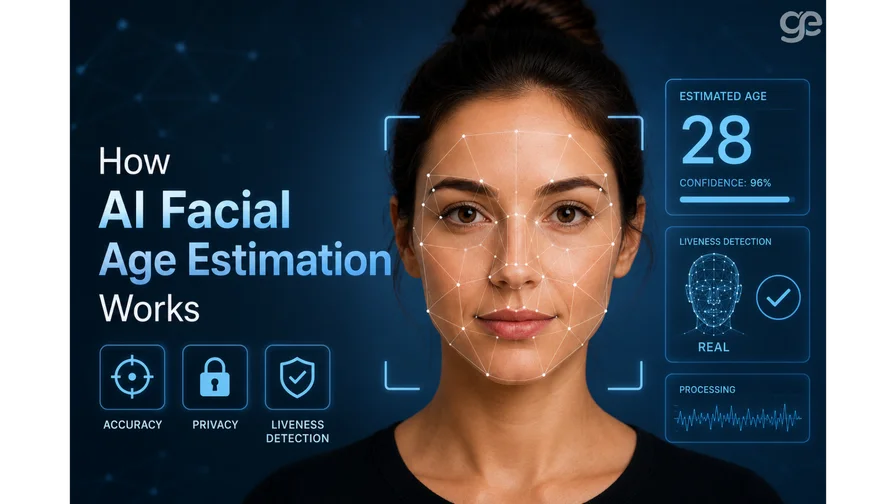
How AI Facial Age Estimation Works: Accuracy, Privacy, and Liveness Detection
Why Facial Age Estimation Is Moving to the Center
Facial age estimation is no longer a niche safety feature. It is becoming part of the compliance conversation for adult platforms, social platforms, gambling operators, and age-restricted commerce because regulators are steadily replacing weak self-attestation with stronger, evidence-based age assurance. In the UK, Ofcom’s 2025 guidance says services that allow pornography must use “highly effective” age assurance, and it explicitly lists facial age estimation as a method capable of meeting that bar when implemented properly. In the EU, the Commission’s Digital Services Act work now includes both protection-of-minors guidance and a privacy-preserving age-verification blueprint for proving a user is over 18. Australia has also moved aggressively, requiring age-restricted social platforms to take reasonable steps to prevent under-16s from holding accounts. Online gambling has long required stronger proof as well: the UK Gambling Commission says online operators must verify age and identity before a customer gambles.
That shift matters because the classic “I am over 18” checkbox is now plainly insufficient. Ofcom says self-declaration, a date-of-birth field without supporting evidence, or a simple “tick the box” confirmation are not highly effective age assurance. France’s CNIL likewise notes that age verification for pornographic content cannot rest on a simple declaration that the user is over 18. In practice, regulators are signaling the same thing: if a control is trivially bypassed, it is not really an age check.
For product teams, that creates a hard balancing act. Businesses need to reduce child access and document compliance, but they also need to protect conversion, avoid unnecessary personal-data collection, and keep legitimate adult users from abandoning a flow that feels invasive. That is exactly where facial age estimation has gained momentum: it is increasingly treated as a low-friction, privacy-conscious method of age assurance when the goal is to answer “old enough or not?” rather than “who exactly is this person?”
What Facial Age Estimation Actually Does
Age assurance is the umbrella term. Under that umbrella, age verification usually answers a binary question by checking trusted information such as a passport or driving licence, while age estimation is a biometric computer-vision technique that produces a probabilistic or continuous assessment, often returning a likely age or age band, such as “21–25,” based on algorithms and facial analysis. The ICO draws that distinction clearly, and the European data-protection authorities recognize age estimation, age verification, and self-declaration as separate categories. It analyzes facial features to estimate a person's age or age range without requiring identification documents.
That distinction matters because age estimation is not the same thing as identity verification. Identity verification is about confirming who a person is; age estimation is about estimating whether that person is likely above or below a threshold, often without relying on formal identity documents. Australia’s Age Assurance Technology Trial describes age estimation as using statistical models to estimate age, with AI and machine-learning algorithms doing so based on various factors, “without identifying the user,” and as increasingly useful where document-based identity is unavailable, inappropriate, or unnecessary. That makes facial age estimation fundamentally different from a KYC-style document flow, even if both can sit inside a broader age-assurance stack.
This is why facial age estimation is often described as privacy-first. If the user only needs to prove “over 18,” a system does not necessarily need their full legal name, address, date of birth, document number, or a permanent copy of a government ID. The EU’s age-verification approach is built around exactly that principle: proving a user is old enough without revealing other personal information.
How the Technology Uses Facial Features in Practice
Under the hood, modern facial age estimation is a computer-vision and machine-learning problem. Contemporary systems generally follow a pipeline like this:
- the user captures a selfie or short video;
- the first stage isolates the face from the rest of the image, locates the bounding box, removes background noise, and aligns the face;
- a trained model extracts age-related visual patterns from the image;
- the model estimates a likely age or age band;
- the product policy applies a threshold or buffer and decides whether to pass, retry, or escalate the user to another method.
Modern systems process a 2D image through several specialized stages before producing an age group or specific year. Age models do not “know” a person’s birthday. They learn correlations between facial appearance and labelled age data. Research and survey literature describes this as a deep-learning workflow in which neural networks, especially CNNs trained on extensive datasets of facial images, extract ageing patterns by analyzing facial features, then map them to an age prediction by regression or classification, with regression treating age as a continuous value and classification treating it as discrete buckets or bins. Training data is central: researchers repeatedly note that model quality depends on the breadth, balance, realism, and scale of the datasets used for learning, often reaching into the millions.
What kinds of signals are being learned? Ageing shows up in both appearance and shape. Systems track facial landmarks such as the location of the pupils, corners of the eyes, and lip boundaries, along with other visible features that change over time. Reviews of facial age estimation point to facial measurements and ratios between landmarks around the eyes, nose, mouth, chin, ears, and forehead, especially for younger faces where craniofacial development is still visible. Other work highlights age-related shifts in skin texture, collagen loss, wrinkles, spots, contrast, elasticity, and facial structure in adulthood and later life. In plain English: the system is learning from patterns in skin, structure, and geometry that tend to change with age, not performing identity recognition.
The underlying models are also getting better. NIST’s Age Estimation and Verification evaluation notes that, on a common visa-image dataset, the best mean absolute error fell from 4.3 years in the 2014 evaluation to 3.1 years in the 2024 report, reflecting a decade of improvement in deep neural network technology; in commercial settings, deep-learning systems analyze pixel patterns and have reported MAE in the 1.1 to 3.1 year range depending on the age group and image quality. NIST’s evaluation remains ongoing, which is important: this is a field where accuracy is still being tested and refined, not a solved problem frozen in time.
What Accuracy Really Means
The most common mistake in this category is asking the wrong accuracy question. There is a major difference between predicting exact chronological age and making a threshold decision such as over/under 18. NIST explicitly says mean absolute error is not the right metric for age-verification tasks, because a consumer-safety flow usually does not care whether the model predicted 24 instead of 26; it cares whether a 17-year-old is mistakenly treated as an adult. In age-prediction benchmarking, though, mean absolute error (MAE) measures the average difference between a model’s predicted age and the subject’s true chronological age. That is why threshold-based policies, challenge ages, buffer zones, false-positive rates, and fallback logic matter more than a single marketing claim about “accuracy.”
This is also why mature deployments use thresholds above the legal limit. NIST describes “Challenge-T” policies in which a system accepts people whose estimated age is above a challenge age and sends everyone else to additional checks. For an 18+ decision, a challenge age of 25 is described as conventional in restricted-age applications, precisely because the buffer reduces the risk of passing underage users. The Australian Age Assurance Technology Trial reached a similar conclusion: outside threshold buffer zones, age estimation can be highly accurate, but near the legal boundary some margin of error is inevitable, so alternative methods are needed in borderline cases.
There are now credible public benchmarks behind that claim. NIST’s 2024 report showed application-image mean absolute error figures in the low-to-mid three-year range for the six algorithms in its summary snapshot, with better results on some datasets and worse on lower-quality border-crossing images. On average, age-estimation accuracy is often around +/- 4.5 years, though controlled conditions can improve that to about +/- 2 years. Some AI tools report results within about ±3 years by analyzing skin condition and fine lines. Australia’s 2025 trial reported that most tested age-estimation solutions delivered low-friction flows, typically under 20 seconds, and that some systems achieved mean absolute errors of about one year in controlled conditions; its summary statistics also reported that most systems achieved at least a 92% true-positive rate at the 18+ threshold when the estimated age was 19 or higher. At the same time, Ofcom has deliberately avoided setting a single universal number like “99% accurate,” instead saying a highly effective method must be technically accurate, robust, reliable, and fair.
Real-world performance still depends heavily on capture conditions. NIST found that border-crossing webcam images with lower contrast and more head-orientation variation performed worse than more standardized office-collected photos, and accuracy can also shift with lighting, head pose, and the quality of the image or video being analyzed; eyeglasses increased error for four of the six algorithms in the report snapshot. The Australian trial likewise evaluated robustness under changes in lighting, resolution, and facial occlusion, and it flags consistency across lighting, devices, and image conditions as a core reliability criterion. Research literature also notes that underrepresentation in training data can create demographic bias, which is one reason fairness testing and dataset diversification remain central design tasks. NIST evaluations also show that accuracy shifts by target demographic, including gender and skin-tone differences, with higher error rates often reported on female faces than male faces. Accuracy can also vary for older faces, and biological aging is highly individualized: genetics, sun exposure, smoking, and lifestyle can all change apparent age relative to calendar age.
Why Liveness Detection Is Non-Negotiable
Even a very accurate age model is not enough on its own. A system that estimates age from a face still has to answer a more basic question first: is there a real live person in front of the camera, right now, or is someone trying to spoof the system? NIST’s PAD materials, citing ISO/IEC 30107, define a presentation attack as presenting an artefact or human characteristics to the biometric capture system in a way intended to interfere with system policy. NIST also notes practical examples, including replay attacks in which an attacker holds up a photo or video to the camera.
That is where liveness detection comes in. In operational terms, liveness detection is the anti-spoofing layer that tries to distinguish a genuine live face from a printed photo, a screen replay, a mask, a synthetic face, or a manipulated video. The Australian Age Assurance Technology Trial says age-estimation providers addressed these risks with presentation-attack detection techniques aligned to ISO/IEC 30107-3, including liveness detection, texture and edge analysis, motion tracking, depth detection, reflectivity checks, and rejection of inconsistent facial landmarks or unrealistic age cues. The same report warns that age-estimation systems are susceptible not only to static images and prerecorded videos, but also to digitally altered faces, deepfakes, and re-aged or age-morphed images.
In practice, teams usually think about liveness in two forms. Passive liveness tries to detect spoofing from the media itself, without asking the user to do anything special; research on remote anti-spoofing notes that passive approaches are easier to deploy because they require no user cooperation. Active liveness adds a challenge-response element, asking the user to perform a task and analyzing both the signal and the behavior during that task. In other words, passive liveness tries to “see” whether the face is real; active liveness may also ask the user to prove it.
This matters for fraud prevention and for regulatory defensibility. NIST’s PAD evaluation reports that it tested the accuracy of 82 passive software-based face PAD algorithms on conventional 2D imagery, which shows how seriously the field now treats spoof resistance as a measurable problem in its own right. The Australian trial similarly treats PAD, secure capture pipelines, input binding, and tamper resistance as important controls for regulated deployments. An age check that can be bypassed with a screenshot is not a serious age check.
Why Privacy Concerns and Compliance Matter
Privacy is not a side issue in age assurance. It is one of the main design constraints. The European Data Protection Board says age assurance can adversely affect not only data-protection rights but also other freedoms, and its 2025 statement prioritizes core GDPR principles including lawfulness, fairness, transparency, purpose limitation, data minimisation, accuracy, storage limitation, confidentiality, integrity, and accountability. It also stresses data protection by design and by default. In the same vein, the EDPB’s public materials say age-assurance processes should not become a back door for further targeting or profiling.
That is exactly why facial age estimation can be attractive compared with document-heavy flows. The ICO distinguishes age verification that checks hard identifiers such as passports or driving licences from age estimation that may simply return an age range based on facial analysis. The EU’s age-verification approach goes further, explicitly aiming to let users prove they are over 18 without sharing any other personal information or sharing identity documents. If the business objective is “can this user enter an 18+ space?”, then collecting a full ID record may be excessive, and reducing document collection can create a more seamless flow that lowers friction and can improve conversions.
That said, privacy-first does not mean privacy-free. The ICO warns that some age-assurance techniques rely on biometric data that can uniquely identify someone, which may place that data in special-category territory under UK GDPR. It also says organisations should minimise bias, provide ways for users to challenge inaccurate decisions, and take extra care where decisions are made solely by automation. This approach can also support inclusivity for people without approved identity documents, helping age-appropriate users access goods and services. CNIL makes a similar point from another direction: current online age-verification systems can be both intrusive and circumventable, which is why it calls for more privacy-friendly models and strongly discourages unnecessary identity-document collection by sites that do not otherwise need to know a user’s identity.
The operational privacy pattern that keeps appearing across official materials is straightforward: collect the minimum necessary data, keep it for the shortest necessary time, secure it in transit and at rest, and avoid retention when you can. Australia’s trial reported strong alignment around temporary biometric processing, no image retention, on-device or edge architectures, secure capture pipelines, and encrypted transmission. Those are not cosmetic product choices. They are what make a facial age-estimation system easier to defend to regulators, privacy teams, and users.
Where It Fits and Where It Still Struggles
The use cases span multiple industries, but they are not identical. Adult-content services are the most obvious example, because of Ofcom’s enforcement and the EU’s over-18 blueprint for adult-restricted online content. Gambling platforms are another, because many jurisdictions already require stronger age checks before wagering. Social media is rapidly becoming a third major category, especially in child-safety regimes like Australia’s. Retail use cases include alcohol and nicotine sales, where the merchant often needs an age answer without necessarily needing a full identity record at the earliest step. Marketing teams also use audience age insights to support age-specific advertising and more tailored experiences for customers. In security, the same approach can help monitor age-restricted areas and support compliance around access to regulated products or services. ICO survey work also shows age assurance appearing in online dating, 18+ gaming, online gaming and game streaming, and music/video streaming. Different sectors, of course, work with different thresholds: 13+, 16+, 18+, and 21+ are all common depending on the law and the product. Used carefully, that kind of signal can improve personalization, increase engagement, and lift customer satisfaction. It can also support demographic analysis, predictive analytics, and age-group outcome studies in health research.
Still, the technology has real limitations. Borderline ages remain the hardest cases. Image quality still matters. Demographic parity is improving but not solved. Deepfakes and digital injection attacks are getting better. And public benchmark numbers do not automatically prove that a complete production flow — with bad lighting, poor cameras, network issues, spoof attempts, and accessibility needs — will behave the same way. NIST is explicit that its age-estimation evaluation is not a certification of a full age-verification process and does not evaluate active attacks on age-verification systems. That is one reason serious deployments lean on fallbacks and layering, rather than trusting a single model output in every case.
The likely future is therefore multi-layered age assurance. Australia’s Age Assurance Technology Trial describes “successive validation” as combining age inference, age estimation, and age verification in sequence so that assurance stays proportionate to risk. The model it describes is elegant: start with the lightest effective method, escalate only if the result is uncertain, and use higher-assurance checks only in edge cases. That is where facial age estimation fits best — not as a magical replacement for every other control, but as a fast first-line tool inside a privacy-aware, fraud-resistant age-assurance stack.
Open questions and limitations
A few issues are still moving targets. International standards are maturing — ISO/IEC 27566-1 was published in late 2025, and related parts remain under development. Regulators still differ on acceptable evidence, acceptable error rates, and what counts as proportionate for a given risk category. And although anti-spoofing evaluation has advanced significantly, deepfake and injection defenses remain an active area of research and standardisation rather than a finished chapter.
Conclusion
Facial age estimation is quickly becoming one of the most important tools in modern age assurance because it can answer the question businesses usually care about — “is this user likely old enough?” — without forcing every user through a full identity-document flow. The strongest systems are not just accurate; they are threshold-aware, buffered around legal boundaries, backed by liveness detection, and designed around data minimisation, short retention, secure processing, and clear fallback paths. That combination is what lets platforms improve compliance and fraud resistance without turning age checks into a privacy or conversion disaster.
If your platform needs age checks that are fast, scalable, and privacy-first, Agemin is built for exactly that reality — AI-powered age verification for modern online platforms, with facial age estimation, liveness-aware protection, and compliance-minded design at the core.
Want to learn more?
Explore our other articles and stay up to date with the latest in age verification and compliance.
Browse all articles